

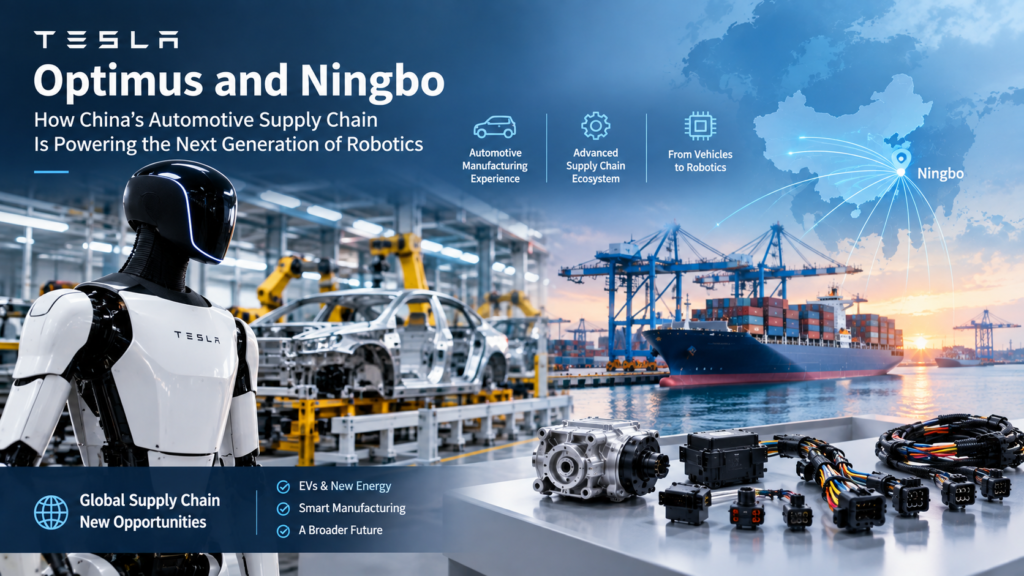
Tesla’s Optimus humanoid robot is moving closer to manufacturing readiness, and one of the more notable developments is unfolding in China’s Yangtze River Delta.
In September 2026, a Tesla robotics team arrived in Ningbo to conduct supplier audits related to Optimus mass production. The team included representatives from design, engineering, purchasing, and supplier management, and later expanded its visits to suppliers in Hangzhou, Shanghai, and other parts of the region.
The significance of this activity extends beyond humanoid robots. Many of the companies under evaluation already supply components to the global automotive industry. This raises a broader question: why is an automotive manufacturing base becoming relevant to the next generation of robotics?
Tesla’s Optimus Moves Toward Production
Tesla has positioned Optimus as part of its longer-term strategy in artificial intelligence and robotics. According to the company’s 2026 disclosures, the third-generation Optimus is its first humanoid robot design intended for mass production. Tesla has been preparing a dedicated production line, with initial output planned before the end of 2026 and a long-term designed capacity of up to one million units per year.
Moving from prototype to volume production, however, is not only a design challenge. It requires consistent quality, efficient processes, stable component supply, and competitive costs. These are precisely the areas where China’s mature automotive supply chain has accumulated decades of experience.
Why Ningbo?
Ningbo is one of China’s major manufacturing centers and has a particularly strong automotive base. The city hosts a dense cluster of suppliers covering chassis systems, precision components, electronics, thermal management, interiors, and other vehicle systems. Many of these companies already serve global automakers and are familiar with automotive-grade quality standards, high-volume production, cost discipline, and strict delivery schedules.
For a program like Optimus, this existing ecosystem offers a practical advantage: suppliers that already understand the demands of large-scale, high-reliability manufacturing.
Automotive Suppliers Expanding into Robotics
Several companies in the Yangtze River Delta with established automotive businesses have been linked to Tesla’s broader Optimus-related supply-chain activities. These include firms such as Tuopu Group, Sanhua Intelligent Controls, and Joyson Electronics—companies that continue to serve the automotive sector while developing technologies applicable to humanoid robots.
The overlap is not coincidental. Capabilities developed for vehicles often translate to robotics:
| Automotive Experience | Potential Robotics Application |
|---|---|
| Precision structural components | Robot body and joint structures |
| Actuators and mechanical systems | Robot joints and movement systems |
| Thermal management | Cooling and thermal control |
| Automotive electronics | Controllers and electronic systems |
| Sensors and control systems | Motion, force, and environmental sensing |
| High-volume manufacturing | Scalable robot production |
These companies are not abandoning automotive work. They are applying existing manufacturing strengths to a new product category.
What Automotive Manufacturing Brings to Robotics
A modern vehicle contains thousands of components and must perform reliably under demanding conditions. Automotive suppliers have therefore built sophisticated systems for precision, repeatability, quality control, and cost management—capabilities that are equally relevant to humanoid robots.
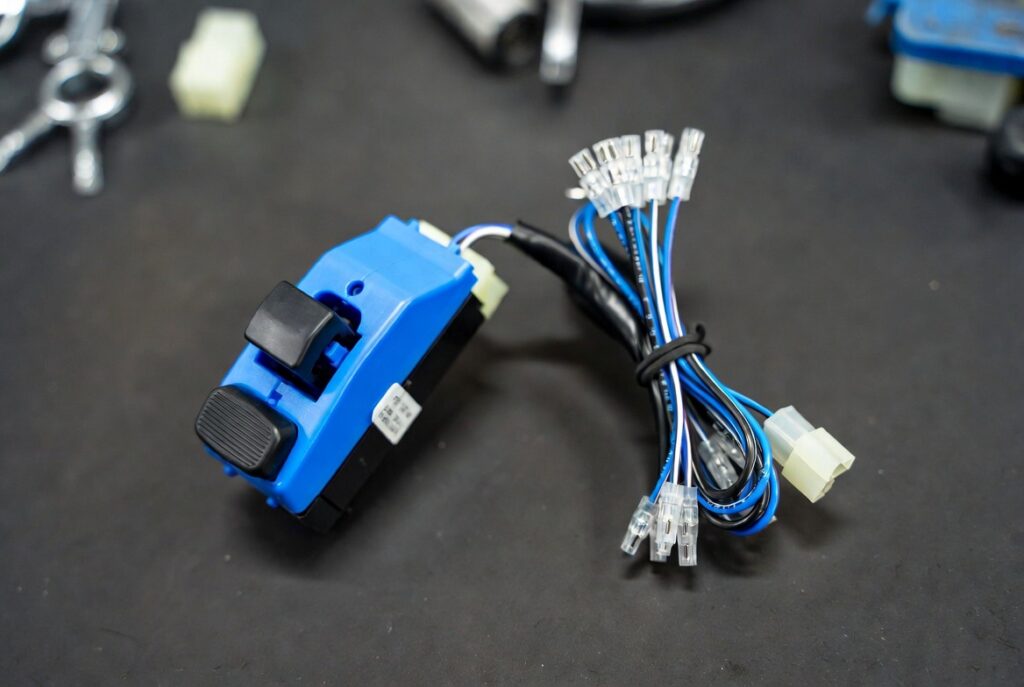
A robot joint, for example, requires precise mechanical parts, actuators, motors, sensors, wiring, connectors, and electronic controls. While the end products differ from traditional automotive components, the underlying manufacturing principles are often similar.
The same supplier may already have experience with:
- Precision machining
- Injection molding
- Metal stamping and forming
- Die casting
- Electronic assemblies
- Motors and actuators
- Sensors and control systems
- Automated assembly
- Quality inspection
- High-volume production
This creates a form of technological transfer: manufacturing know-how developed for automotive applications can be adapted to robotics when the core requirements—precision, reliability, and scalable output—align.
The Advantage in Mass Production
Building a prototype robot is fundamentally different from producing thousands or millions of units. At the prototype stage, engineers can adjust parts and processes manually. At scale, every component must meet the same specification repeatedly, while costs and cycle times remain under control.
Automotive suppliers have spent decades refining exactly these systems:
For a company attempting to move a humanoid robot from engineering prototypes to industrial-scale production, these capabilities can be as critical as the robot’s software and AI.
The Broader Yangtze River Delta Ecosystem
Tesla’s supplier activity is not limited to Ningbo. The robotics team has also visited companies in Hangzhou, Shanghai, and other parts of the Yangtze River Delta. This region combines automotive production, electronics, precision manufacturing, machinery, and logistics into one of China’s most developed industrial clusters. The density of suppliers can shorten development cycles and improve coordination for complex programs.
The development of Tesla’s Optimus supply chain should therefore be viewed not simply as a story about one city, but as part of the broader connection between China’s automotive manufacturing base and the emerging robotics industry.
Implications for China’s Automotive Parts Industry
The Optimus example illustrates how automotive manufacturing capabilities can extend into adjacent fields. For component suppliers, this does not require leaving the vehicle market. It can create additional applications for existing technologies in electrical systems, connectors, sensors, motors, and precision assemblies.
As the boundaries between automotive electronics, robotics, AI, and industrial automation continue to blur, suppliers with strong process discipline and scale experience are well positioned to participate in new categories of products.
Looking Ahead
Tesla’s Optimus program remains in development. The ultimate scale and timing of mass production will depend on manufacturing readiness, supplier capacity, and continued product refinement.
What is already visible is the growing interaction between Tesla’s robotics efforts and China’s established automotive supply chain. Ningbo’s involvement is one early signal of that connection. The city is not merely a center of traditional automotive component production; it is becoming part of a broader industrial network that links vehicle manufacturing expertise with the emerging requirements of humanoid robotics.
Conclusion
Tesla’s recent supplier activity in Ningbo highlights a larger trend in global manufacturing: the capabilities developed for the automotive industry are increasingly being applied to new fields such as humanoid robotics.
For China’s automotive component industry, this represents an interesting example of how manufacturing expertise, supplier networks, and engineering capabilities can create opportunities beyond traditional vehicle applications.
As Optimus moves from engineering development toward production, the performance of its supply chain may prove as important as the technology inside the robot itself.